Showing posts with label viking beads. Show all posts

Monday, December 20, 2021

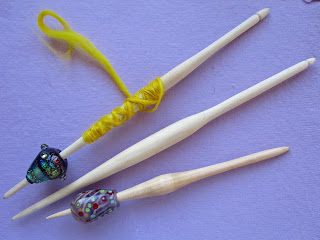
My own spindle sticks

I've been telling myself (and a few other people) that I really need to figure out how to use a lathe and make my own spindle sticks for a while now. I am venturing down that road (with a bit of trepidation). Why bother, you ask? Well I have found precisely one person who can make the sticks I need for a sensible price. Well, for any price, really. And what if Hershey Fibers gets tired of it? Then I will have a pile of stick-less whorls lying about and no one will know what to do with them! So~ away we go!

For starters, using a lathe is a little fun, a little hard on one's body and a little scary. There's a whole lot of shakin' going on! And I am no spring chicken. Secondly, these thin sticks take some finesse. As they thin out, you need a sharp tool to do the work for you, no pushing allowed. I am working at The Hub, and the tools seem a bit over used. So I switch to sand paper near the end. And then I get tired of standing there and just stop and bring it home to finish it. Which is kind of silly as it takes a lot longer to finish by hand!

Anyway, I am fairly pleased with the results. I've paired some whorls up with particular sticks in my etsy shop. How are these sticks different?

  • They are a bit thicker than the ones I can buy, which I like~ they feel firmer in my hand. 
  • The 'flick area' is thicker. I am working on narrowing that.
  • The centers are wider; the shape is not quite what I envisioned, but they're on the way!
  • Some of them are shorter, which is also my preference.
  • They can be notched for drop spinners more easily.
  • They are not all the same. This means that specific whorls work best on specific sticks. I'll be working on getting things a bit standardized in future, though I like that they are not all perzactly the same!
  • A little oil & beeswax finish is rubbed on.
  • Right now I am working with poplar, but Urban Timbers just may be able to provide me with some locally saved wood. I love that idea!

Tuesday, April 19, 2016

Modern Medievals- Lampwork Glass Beads With a Historical Twist

It's time to introduce a new 'line' of handmade lampwork beads- 'Modern Medievals.' What the heck does that mean, you may ask? This bead grouping is made up of beads that are designed using techniques that have been around for millenniums using basic tools and glass colors. These are not copies of historical finds, but rather somewhat modernized versions of these beads that will encompass some different shapes and color combinations. Here are a few examples:

Stacked dots or 'horned' beads. This style was extremely popular during the warring states period in China. Though first imported there from countries to the west such as Egypt and Mesopotamia, the popularity of these beads encouraged the Chinese to begin making their own. These beads are made up of different colors of glass stacked one on top of the other and melted together. They have a lot of texture, which makes them a bit fun to wear. Most of the historical finds are round. My beads will encompass other shapes, like these conical beads.


'Eye' beads are a close relative of the stacked dots; as a matter of fact, stacked dot beads are also often referred to as eye beads. In the classical version of the eye bead, the dots are melted together. The eyes can be made from just two colored dots melted together, or many. The two beads in this photo could both be considered 'eye beads', though one has raised stacked dots. In some cultures this type of bead is worn to ward off the evil eye. One of these beads has a fine silver foil core, a technique. practiced as far back as the Viking era, or about the 10th century. The other has twisted glass (twistie) decorations, a technique I have observed to be present in many ancient beads, some over 2000 years old.

Beads that have been 'feathered', 'combed' or 'raked' have also been around for a very long time. The three techniques are quite similar, using a tool or point of a glass rod to pull lines of glass laterally across the bead. Some of the beads pictured are cone shaped. These could have been used as whorls on wool spindles, or worn decoratively, or both (as some of my friends do).

The last technique I will mention here is that of folding glass. Tom and Sage Holland re-discovered the methods of making this type of bead after a lot of trial and error. An article explaining how this is done can be read in volume 29, issue 4 of Ornament magazine. I have as yet to make any of these for the 'Modern Medievals' collection, but they will be coming soon.

For more interesting information about ancient glass beads, you can search the collection at the Corning Museum of Glass , or visit the Viking Answer Lady. You can also visit my Pinterest page , Historical Glass Beads.